Aug 11, 2026
Where Are Bluetooth Speakers Made in China?
A practical guide to sourcing portable Bluetooth speakers in Shenzhen, Dongguan and Huizhou, including price-tier differences and supplier checks.
By Reality Sourcing · Reviewed and updated August 2, 2026
If you are sourcing portable Bluetooth speakers, one of the strongest places to start is the Guangdong electronics corridor—especially Shenzhen, Dongguan and Huizhou. This guide focuses only on that corridor; speaker production also exists elsewhere in China. These three cities are close enough to work as one supply network, but they are not interchangeable.
The short version: Shenzhen is strongest for product definition and fast electronics development, Dongguan for manufacturing depth and component coordination, and Huizhou for established electronics production and mature OEM/ODM programs. This is a sourcing rule of thumb, not a guarantee. The right factory is determined by engineering ability, quality systems and project fit—not its city alone.
Shenzhen: product development and fast supplier access
Shenzhen is often the fastest starting point when a speaker project still needs decisions. Its wider intelligent-terminal ecosystem gives buyers access to industrial design, electronics solution companies, Bluetooth modules, PCB development, firmware resources and rapid prototyping. The Shenzhen Municipal Government describes a complete intelligent-terminal chain from core components to branded terminal products; applying that ecosystem to speaker sourcing is our field interpretation.
Choose Shenzhen first when you need:
- a quick proof of concept or functional sample;
- help selecting chipsets, modules or charging solutions;
- industrial design and enclosure development;
- frequent engineering communication;
- access to several supply options in a short time.
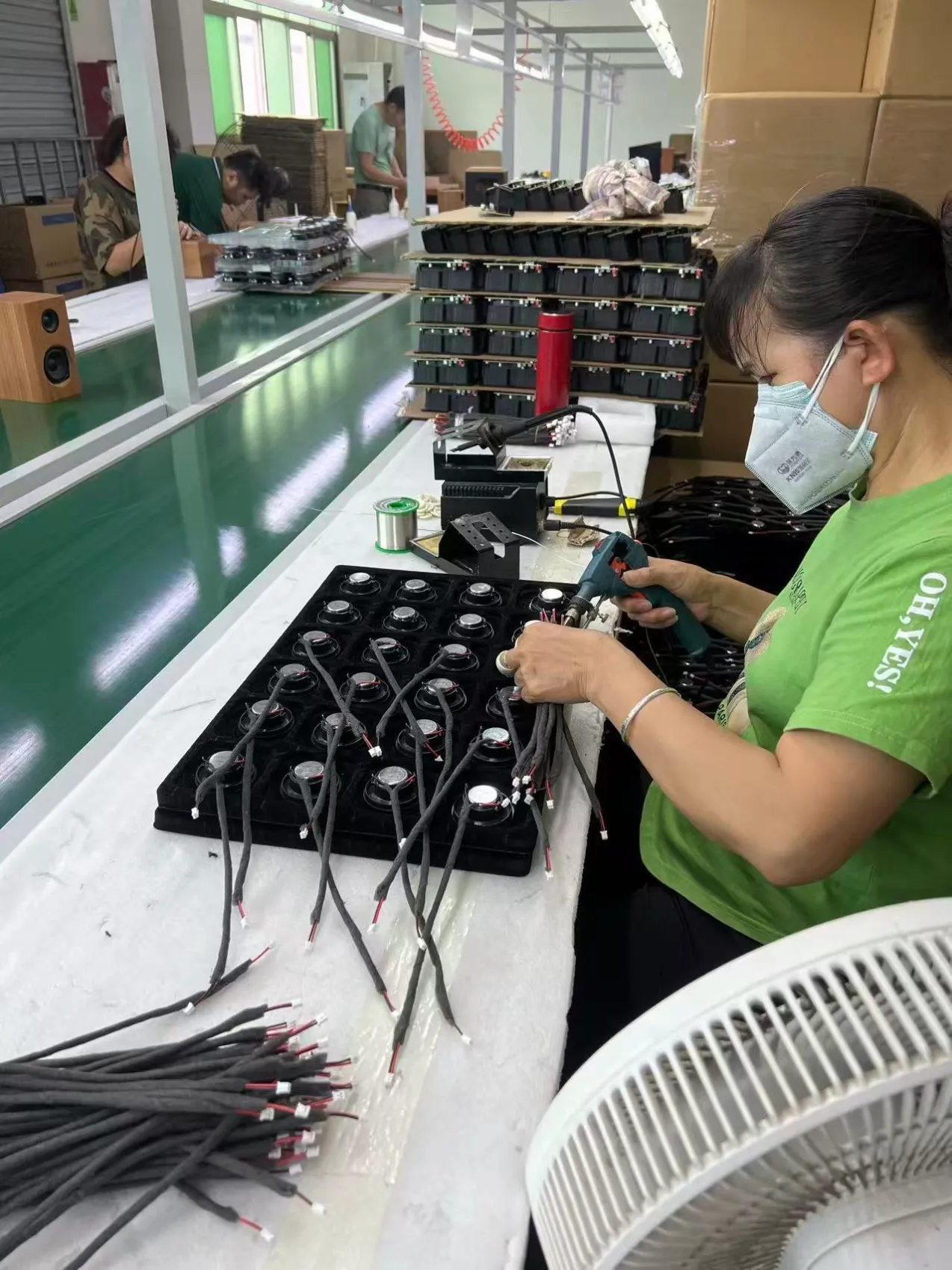
One important warning: a Shenzhen address does not necessarily mean the production line is in Shenzhen. Many sales, design or project-management offices coordinate factories in Dongguan, Huizhou or elsewhere. Ask where tooling, SMT, assembly and final inspection actually happen.
Dongguan: tooling, components and assembly depth
Dongguan is a strong choice when the project depends on close coordination between plastic tooling, metal parts, PCBs, batteries, acoustic components, assembly and packaging. The Dongguan Investment Promotion Bureau describes an electronic-information ecosystem spanning components through finished products. That is city-level electronics information, not a speaker-specific factory count.
For speaker buyers, that broader manufacturing depth is useful when a project has:
- a custom plastic, silicone or metal enclosure;
- complex waterproofing or sealing requirements;
- several cosmetic finishes and tight color matching;
- demanding assembly tolerances;
- a need to improve cost after the design is stable.
Dongguan is not automatically cheaper. A capable factory with disciplined engineering may quote more than a basic assembler, but it can reduce tooling rework, inconsistent sound and late-stage quality failures.
Huizhou: mature electronics manufacturing and scalable programs
Huizhou has a large electronic-information base covering smart terminals, core electronics and energy-storage products. A 2025 Huizhou Industry and Information Technology Bureau response reported RMB 569.133 billion in 2024 output for the wider electronic-information cluster. This is not speaker-only output. In practice, the supporting electronics base can make Huizhou a useful starting point for mature programs that need stable OEM/ODM execution rather than constant concept changes.
Reality Sourcing’s Guangdong project experience suggests looking at Huizhou when:
- the acoustic and electronic platform is already defined;
- the order needs stable repeat production;
- the product uses established battery and electronics supply chains;
- the buyer wants an experienced OEM/ODM partner for a longer program.
This is practical sourcing guidance, not a claim that every Huizhou electronics factory specializes in audio. Verify the supplier’s recent speaker projects, acoustic test equipment and production records.
Which city should you start with?
Your project need | Typical starting point | Why |
|---|---|---|
Fast concept or working prototype | Shenzhen | Dense design, solution and electronics resources |
Custom enclosure, tooling and multi-part assembly | Dongguan | Strong manufacturing and component coordination |
Mature OEM/ODM speaker for repeat production | Huizhou | Established electronics production base |
Lowest risk for a complex program | Compare all three | Factory capability matters more than the city |
Reverse the default choice when the evidence points elsewhere. Existing customer-owned tooling can make the tooling location more important than the sales office; a firmware-heavy product may keep engineering close to Shenzhen; a large repeat order may favor the factory with verified capacity regardless of city. Search beyond Guangdong when a required material, process, existing mold, licensed technology or proven supplier relationship is concentrated elsewhere. The purpose of this guide is to narrow the first search—not to claim that Guangdong is the only production base in China.
What changes between entry, mid-range and premium speakers?
Price differences are not just about the size of the driver. The tiers below are buyer-side verification expectations, not universal factory classifications.
Entry-level
Entry products often use an existing acoustic platform, standard ABS tooling, basic Bluetooth functions and limited tuning. Check whether battery capacity, output power and playtime claims are measured consistently. Low prices can hide downgraded cells, thinner materials or a different internal BOM after sample approval.
Mid-range
Mid-range projects usually invest more in driver selection, passive radiator design, waterproofing, charging safety, microphone performance and consistent acoustic tuning. They may also require better finish control, packaging tests and market-specific compliance documents.
Premium
Premium speakers require more engineering discipline: DSP tuning, acoustic chamber control, material selection, firmware stability, reliability testing and tighter unit-to-unit consistency. A factory that can assemble a generic speaker is not necessarily capable of delivering a premium audio product.
For any tier, verify the claimed upgrade rather than accepting a marketing label. Compare the sample BOM, driver and battery specifications, firmware version, acoustic-tuning record and reliability report. Test the approved sample against the same written method you will use for production inspection.
Put these details in your RFQ
A useful speaker RFQ should state:
- target retail price and target FOB or EXW cost;
- expected order quantity and annual volume;
- speaker size, output target and listening scenario;
- Bluetooth version, codec and required functions;
- battery capacity, target playtime and charging method;
- waterproof rating and drop-test expectations;
- microphone, app, TWS or firmware requirements;
- required certifications and sales markets;
- packaging format, accessories and launch deadline.
Without this information, quotations from different suppliers are rarely comparable.
Supplier red flags
Be cautious when a supplier:
- avoids showing where production takes place;
- cannot explain the approved BOM;
- makes unrealistic wattage or battery-life claims;
- provides certificates that do not match the model or applicant;
- has no method for checking acoustic consistency;
- treats the golden sample as a visual reference only.
How to verify that a supplier is an actual fit
Before comparing final quotations, ask each candidate for the same evidence:
- the legal company name, business scope and address of the production site;
- which company owns or controls tooling, SMT, acoustic tuning, assembly and final inspection;
- a live or recorded factory walk-through tied to the quoted model;
- the engineering team responsible for acoustics, firmware and structural design;
- recent production and test records for comparable speaker programs;
- the approved BOM, change-control process and golden-sample procedure;
- available tests for frequency response, distortion, playtime, charging, waterproofing, drops and aging;
- monthly capacity, peak-season constraints and subcontracted processes.
Use a simple shortlist score: give each item 0 when evidence is missing, 1 when it is partly documented and 2 when it is verified. Treat legal identity, actual production address, BOM control and required safety/compliance evidence as mandatory pass/fail items. Do not compensate for a failure in those four areas with a high total score. For the next stage, request at least three production-equivalent samples and define written acceptance limits before testing; final sample size and thresholds should follow the product risk, order quantity and agreed inspection standard.
For samples, define one test method for every important claim. For example, record playback volume and source material for battery-life tests, the distance and method used for sound-level measurements, and the exact IP test standard. Otherwise, two suppliers can report different results while both appear to “pass.”
The practical next step
Start with the city that matches your current project stage, then compare suppliers on engineering, production ownership, quality control and commercial fit. For most buyers, a verified shortlist across the Shenzhen–Dongguan–Huizhou corridor is more useful than searching hundreds of listings nationwide.
Reality Sourcing can review your requirements, identify suitable factories, coordinate samples, negotiate pricing and manage quality through shipment. Send us your target market, expected volume, target cost, feature list, compliance needs, customization scope, reference files and launch date. For a complete brief, we target an initial response within 24 hours on China business days.
If your project also needs charging and battery-protection accessories, see our smart full-charge auto-cutoff protector.