Aug 11, 2026
Where Kids Tablets Are Made in China
Compare Shenzhen, Dongguan and Huizhou for kids tablet design, PCBA, plastics, batteries, assembly, quality control and OEM sourcing.
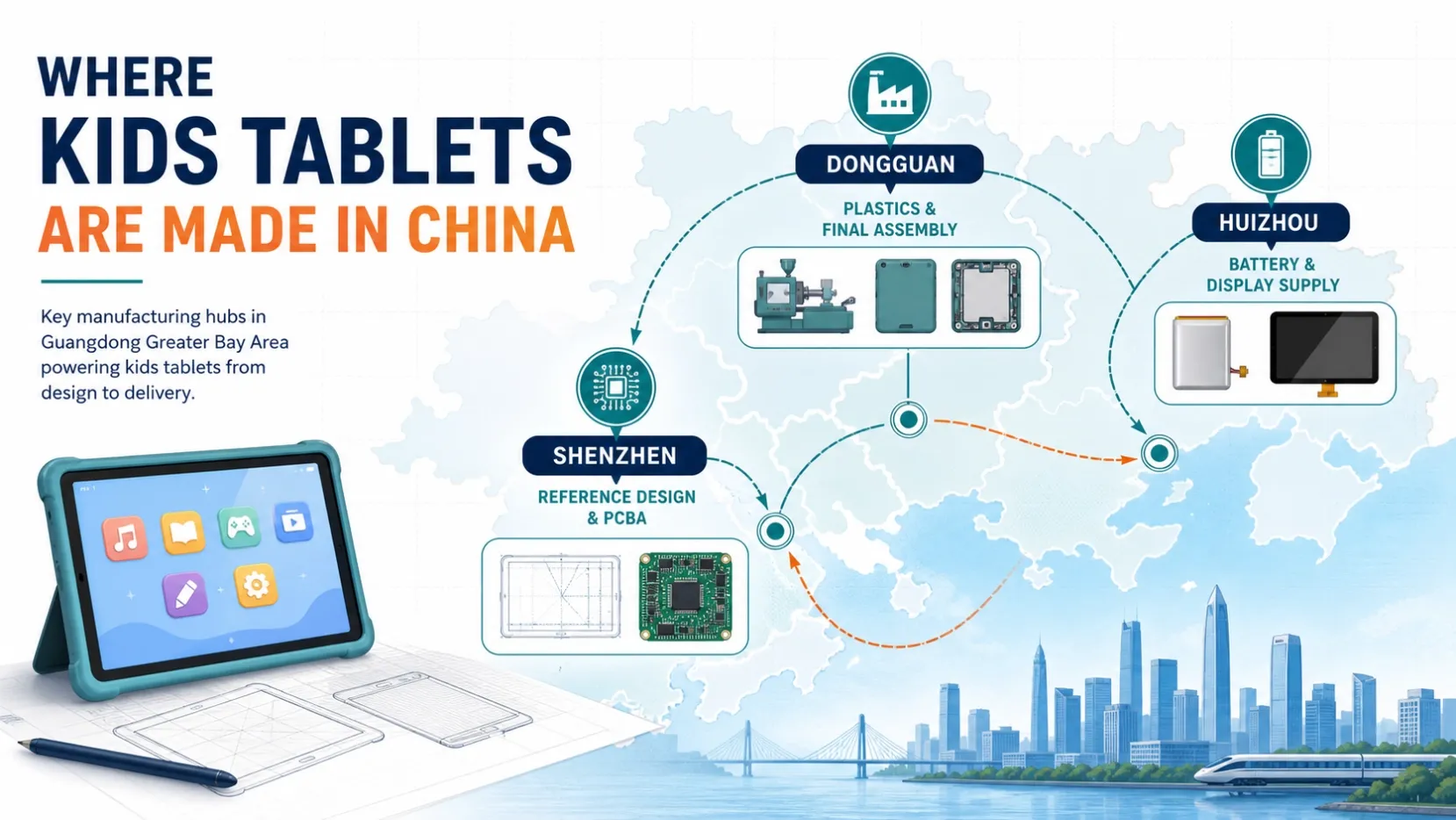

China's kids-tablet supply chain is not contained in one factory or one city. A supplier may sell a finished tablet from Shenzhen while its molded case, battery, display subassembly or final production work comes from nearby Dongguan or Huizhou. Understanding these roles helps buyers choose the right partner and avoid comparing quotations that are not technically equivalent.
Planning a kids-tablet project? Send the target age, market, screen size, GMS requirement, quantity and launch date so we can compare suppliers against one brief.
The short answer
- Shenzhen is the main center for reference designs, PCBA platforms, Android integration, firmware and product management.
- Dongguan is strong in plastics, molds, protective cases, accessories and volume assembly.
- Huizhou contributes batteries, displays, electronic components and contract manufacturing capacity.
These are common sourcing-pattern inferences, not rigid boundaries. Verify every supplier by asking who owns the firmware, who purchases controlled components, and where final assembly and outgoing inspection occur. City location alone is not evidence of capability.
Shenzhen: reference design, PCBA and software
Shenzhen's electronics ecosystem makes it the usual starting point for a new Android tablet program. Buyers can find board-design companies, chipset solution providers, display and camera vendors, firmware teams, testing services and exporters within a compact network. Shenzhen's municipal description of its key industries highlights the city's advanced electronics and information-technology base, which supports this role.
For an ODM kids tablet, a Shenzhen supplier may begin with an existing motherboard and enclosure platform. It can then change memory, storage, cameras, battery, launcher, boot animation, parental-control software and packaging. This speeds development, but creates questions that must be answered early:
- Is the stated RAM entirely physical, or does it include virtual memory?
- Is Google Mobile Services licensed for the exact model and destination?
- Who owns the launcher and parental-control software?
- How long will OTA and security updates continue?
- Can the supplier lock the approved PCB, display and battery?
A trading company may present the same platform as a factory-owned design. Ask which entity owns the firmware, purchases the PCB and controls final assembly.
Dongguan: tooling, plastics and scalable assembly
Dongguan has a broad manufacturing base and deep supporting industries. Its role in a kids-tablet project often includes injection molding, silicone or EVA protective cases, metal parts, cables, chargers, packaging and final assembly. Dongguan's official industrial profile emphasizes its large manufacturing economy and electronic-information sector.
This city becomes especially relevant when a brand needs a distinctive case or enclosure. Tooling can create a recognizable silhouette, handle, stand or bumper, but it raises the cost and schedule of the project. Before opening a mold, agree on:
- 2D and 3D drawings with ownership terms
- Mold life, cavity count and maintenance responsibility
- Case-material hardness, odor and restricted-substance requirements
- Drop-test height, surface and number of impacts
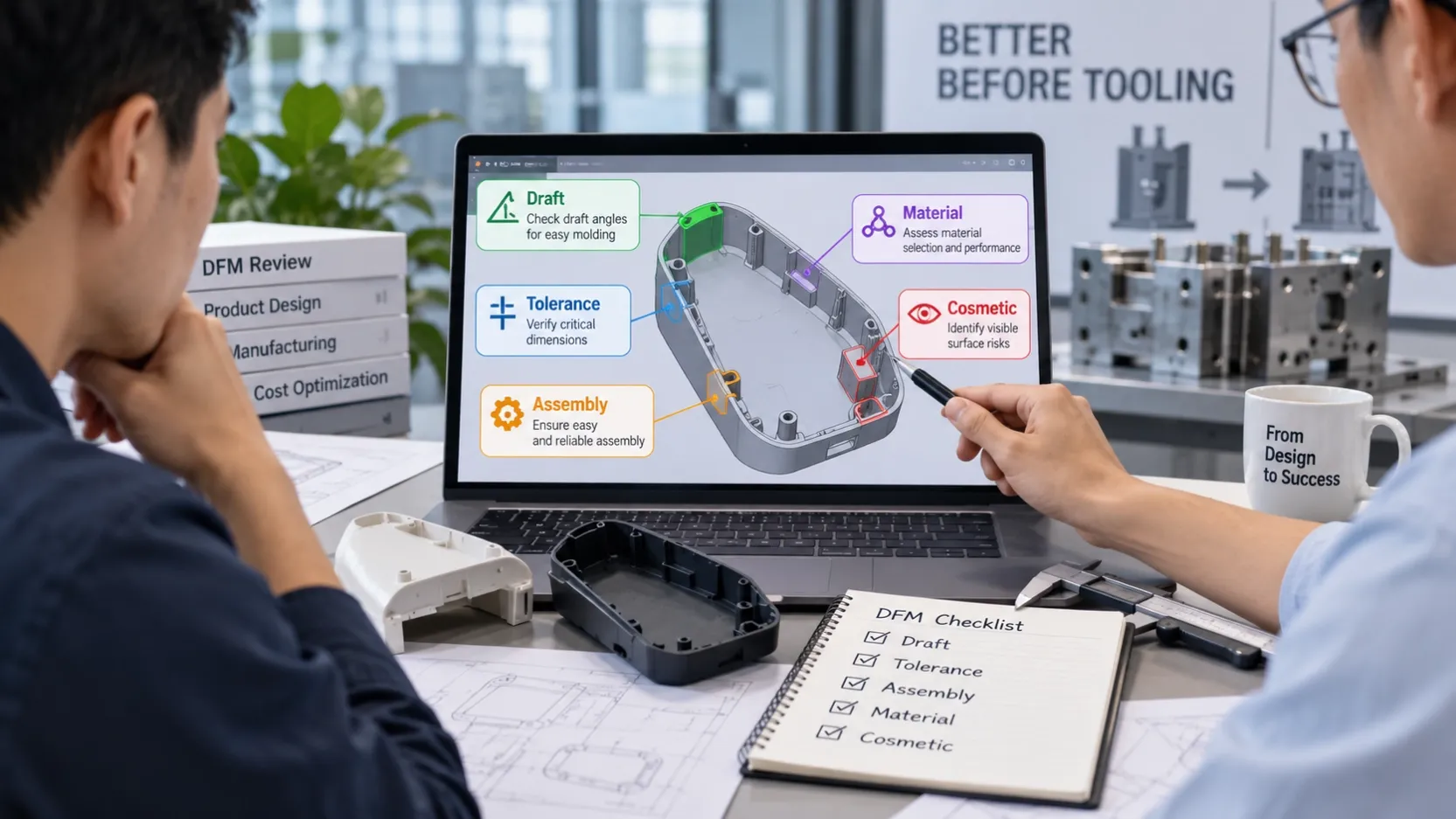
- Dimensional tolerances around buttons, ports and cameras
For established platforms, Dongguan assembly can also support higher volumes. Buyers should still verify whether the quoted plant performs PCBA, final assembly, packaging or only one portion of the process.
Huizhou: batteries, displays and supporting production
Huizhou sits close to Shenzhen and Dongguan and is part of the same practical procurement radius. The Guangdong-Hong Kong-Macao Greater Bay Area portal describes Huizhou's Zhongkai zone as a national electronic-information base with mobile-communications, panel-display, automotive-electronics, LED and new-energy supply chains. This supports a component and manufacturing role, but it does not prove that any specific vendor makes kids tablets. Factory-level verification remains necessary.
Battery specifications deserve more scrutiny than a printed capacity label. Request the cell maker and model, rated capacity, pack-protection design, cycle test, charging temperature and shipment documents. Run a timed discharge test on production-equivalent samples. For displays, define panel maker or approved alternatives, brightness, resolution, touch performance, defect limits and substitution rules.
Entry, mid-tier and premium configurations
Tier | Typical configuration | Main trade-off |
|---|---|---|
Entry | 7-inch display, basic SoC, 2GB physical RAM, simple case | Low price, but slower performance and shorter usable life |
Mid-tier | 10.1-inch HD IPS, 4GB physical RAM, 64GB storage, dual-band Wi-Fi | Better balance for mainstream ecommerce and education bundles |
Premium | Faster SoC, improved display, verified GMS, stronger audio, longer software support | Higher BOM and more demanding validation |
Virtual memory can make an entry platform appear stronger in a listing without improving it like additional physical RAM. A signed specification sheet should state physical RAM, virtual allocation and usable storage separately.
Quality control before shipment
A kids-tablet inspection should go beyond cosmetic sampling. Include boot and shutdown, touch-grid accuracy, Wi-Fi and Bluetooth stability, cameras, speakers, microphones, charging, battery runtime, standby drain, buttons, ports, memory verification and software version. Check case fit and repeated drops on an agreed method. Packaging should be tested for the intended courier or pallet-shipping route.
The inspection sample must match the approved golden sample. Record PCB, display, battery and charger identifiers so substitutions can be detected. Compliance reports should identify the exact model and configuration. For a US launch, map FCC scope to the final radios, review the external power supply, obtain battery-transport documentation and document child-directed data flows for COPPA review. If the positioning and play value classify the item as a toy, toy-safety rules may also apply. EU CE/RED and RoHS belong in a separate destination plan. A qualified lab or counsel should confirm the final requirements before mass production.
Use a supplier scorecard rather than an address filter. Record the legal contracting entity, firmware owner, GMS model status, assembly location, controlled-component purchasing party, traceability method, MOQ breaks, sample lead time, production lead time and available audit evidence. This separates a platform owner, an assembler and a trading company even when all use the same product photos.
Choosing the right supplier model
Choose a Shenzhen-led ODM when software, fast iteration and a known tablet platform are the priorities. Add a Dongguan tooling or assembly partner when the enclosure and case must be distinctive. Give extra attention to Huizhou battery, display or manufacturing resources when scale and core component control matter. These are sourcing-model examples rather than rules; verify the legal entity, ownership and actual production location for each quotation.
Reality Sourcing can map who controls the design, verify the physical configuration, compare suppliers on the same specification and manage sample and production checks. Review the recommended kids Android tablet specification, learn about our OEM and ODM support, or send your project brief with the target age, market, screen size, quantity and required software.
Sources
Research and illustration prepared 10 August 2026. City roles describe common Greater Bay Area sourcing patterns and should be verified for each supplier.