Aug 19, 2026
Where Mini PCs Are Made in China: Shenzhen, Dongguan and Huizhou Compared
Compare Shenzhen, Dongguan and Huizhou mini PC supply-chain roles, supplier types, price tiers, testing and RFQ controls.
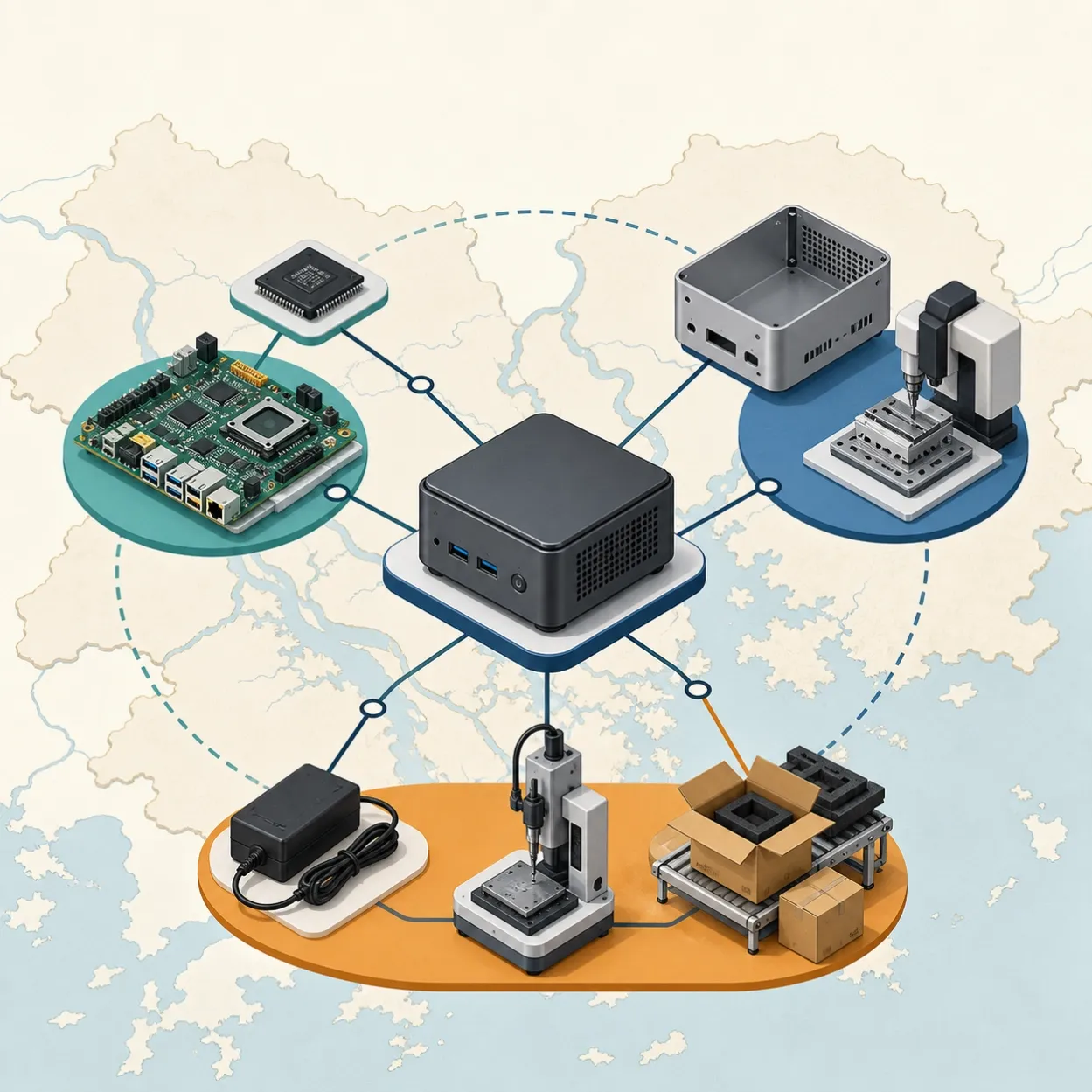
China's mini PC supply chain is concentrated in the Guangdong-Hong Kong-Macao Greater Bay Area, but it is not located in one factory or one city. A typical program may use a Shenzhen platform company, a Dongguan enclosure or assembly supplier and a Huizhou power-adapter or component partner.
That division is a sourcing pattern, not a guarantee. A supplier's actual engineering ownership, production address, approved subcontractors and quality system still need to be verified project by project.
The short answer
- Shenzhen: strongest for motherboard platforms, product definition, BIOS and firmware coordination, solution companies and electronics trading.
- Dongguan: strong for CNC machining, die casting, tooling, cables, packaging, final assembly and scalable manufacturing around Shenzhen-developed platforms.
- Huizhou: useful for power supplies, electronics components, batteries and contract manufacturing, with short transport links to Shenzhen and Dongguan.
Official city materials support the broader industrial picture. Shenzhen continues to emphasize its electronic-information and intelligent-terminal sectors. Dongguan describes electronic information as a pillar industry and has deep manufacturing infrastructure. Huizhou highlights an electronic-information cluster covering terminals, components and energy-related manufacturing.
Shenzhen: platform ownership and product engineering
Many mini PC quotations look similar because multiple sellers can use the same motherboard platform. Shenzhen is where buyers are most likely to encounter platform owners and solution companies capable of changing the motherboard, BIOS, port allocation, boot image or remote-management behavior.
The important question is not whether the company has a Shenzhen address. Ask who owns the schematic and BIOS, where the board is assembled, who controls component substitutions and how long drivers and firmware will be maintained. A trading company may present good samples while having no authority over these decisions.
Shenzhen is a logical starting point when the project needs:
- a custom I/O layout or motherboard revision;
- BIOS, boot-logo or firmware work;
- Windows or Linux image coordination;
- fast access to memory, storage, wireless and connector suppliers;
- a short engineering feedback loop during prototyping.
Dongguan: enclosure, tooling and production execution
Dongguan's value appears when a mini PC moves from a reference design into a controlled physical product. The city and surrounding towns have extensive CNC, die-casting, stamping, injection-molding, cable and packaging capacity. These capabilities influence thermal performance, cosmetic consistency, assembly time and landed cost.
A capable Dongguan assembler may integrate a Shenzhen motherboard with a custom aluminum enclosure, heat sink, fan, antenna, cable set and retail package. Buyers should still identify which operations are in-house. “Factory” can mean final assembly only, while metalwork, PCBA and adapters are subcontracted.
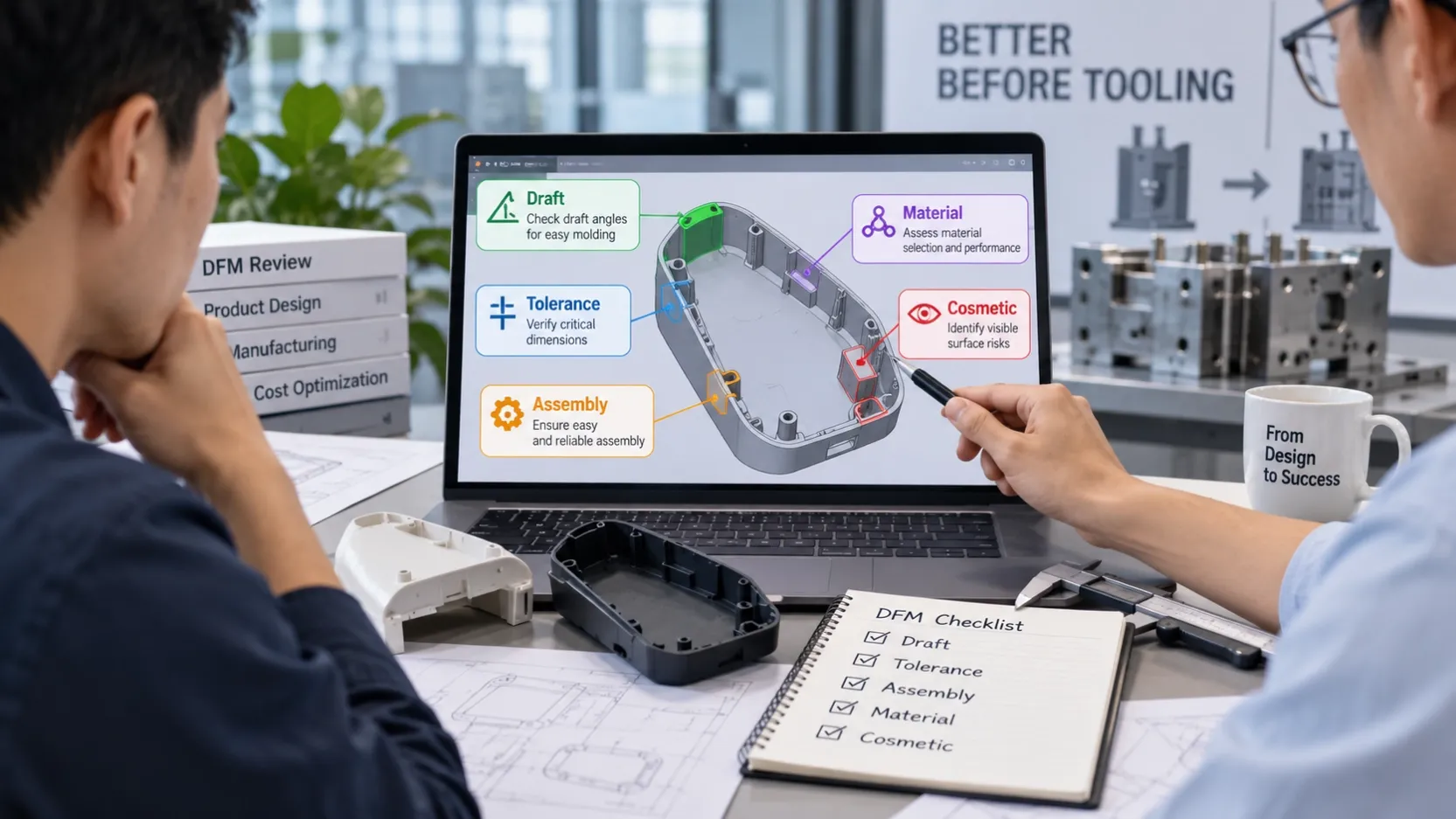
Verify enclosure drawings, alloy or resin grade, surface treatment, heat-sink contact, fan specification, antenna position and packaging protection. A beautiful sample can hide thermal throttling or unstable Wi-Fi caused by the final enclosure.
Huizhou: power, components and complementary manufacturing
Huizhou is part of the same practical supply radius and has established electronic-information and energy-related manufacturing. For mini PCs, the city can contribute adapters, power components, cables, batteries for specialized designs and contract manufacturing.
The power adapter deserves its own supplier review. Confirm the exact manufacturer, efficiency level, safety certificates, plug, cable gauge, output tolerance and performance under full CPU/GPU load. An approved mini PC paired with an unapproved adapter is not an approved final product.
Four supplier types buyers will meet
- Platform owner or solution company: controls the motherboard and some BIOS/firmware work.
- Enclosure and parts factory: makes the case, heat sink, tooling or cable set but may not control the computer platform.
- Final assembler: purchases the platform and components, loads software, tests and packs the product.
- Trading company: coordinates multiple suppliers and may offer useful service, but its technical and change-control authority must be clear.
The right model depends on the project. A standard N150 private-label order may work with a disciplined assembler. A custom-port or long-lifecycle industrial program needs direct access to the platform owner and documented component control.
Price tiers and what actually changes
Tier | Typical configuration | What buyers should examine |
|---|---|---|
Entry | N150, 8GB/256GB, basic enclosure | memory/storage identity, USB-C claims, cooling and adapter |
Mid-tier | N150, 16GB/512GB, Wi-Fi 6, better case | dual-display stability, SSD endurance, thermal/noise balance |
Premium | Ryzen/Core, 32GB/1TB, dual 2.5GbE, triple display | board ownership, BIOS support, high-load thermals and lifecycle |
The cheapest quotation often leaves RAM and SSD brands open. That flexibility can create inconsistent performance and returns. Require an approved vendor list, part numbers or minimum performance/endurance specifications, plus written approval before substitution.
Quality controls before mass production
Lock the platform and components
Record the motherboard revision, processor, RAM, SSD, wireless module, fan, heat sink and adapter from the approved sample. Keep a golden sample and signed configuration sheet.
Validate thermals and noise
Run simultaneous CPU and graphics stress in the final enclosure. Log temperature, frequency, fan speed, surface temperature and acoustic result. Repeat in the buyer's expected ambient-temperature range.
Test software ownership
Define who maintains BIOS, drivers, security patches, recovery images and Linux support. If Windows is supplied, verify the licensing route for the exact device.
Test interfaces and radio performance
Check every port, display mode, sleep/wake cycle, power recovery, Wi-Fi throughput, Bluetooth coexistence and Ethernet speed. USB-C data, charging and display functions must be written explicitly.
Control final assembly and shipment
Use production-equivalent burn-in, visual inspection, serial-number records and packaging/drop validation. Confirm spare boards, fans, adapters and repair procedures before the first shipment.
RFQ information that produces comparable quotations
Send every supplier the same brief:
- target use case, countries, forecast and selling-price range;
- processor, physical RAM and SSD requirements;
- port map, display modes and network configuration;
- enclosure material, dimensions and finish;
- thermal and acoustic limits;
- OS, licensing, BIOS and driver-support term;
- adapter, certifications and packaging;
- pilot quantity, mass-production MOQ and delivery target;
- warranty, spare-parts and component-substitution rules.
How Reality Sourcing can support the project
Reality Sourcing can identify which supplier owns the platform, compare assemblers, coordinate custom enclosure and firmware work, validate thermals and ports, and keep production components aligned with the approved sample. This reduces the risk of buying a good-looking sample that cannot be reproduced consistently.
Start with our N150 mini PC sourcing guide, review our product-development capabilities, or send us your mini PC specification for a supplier and feasibility review.